The Shift from Curiosity to Practicality
AI is quickly moving from “nice to have” to a practical business tool. But for many small and medium businesses, the challenge is not whether to use AI. It is knowing where to start and which tools will genuinely improve the way the business operates.
The businesses I speak with are not looking for more technology for the sake of it. They want efficiency. They want teams spending less time on repetitive tasks and more time on meaningful work that drives growth and improves customer experience.
Where AI Creates Real Efficiency
Used well, AI can create major productivity gains across daily operations.
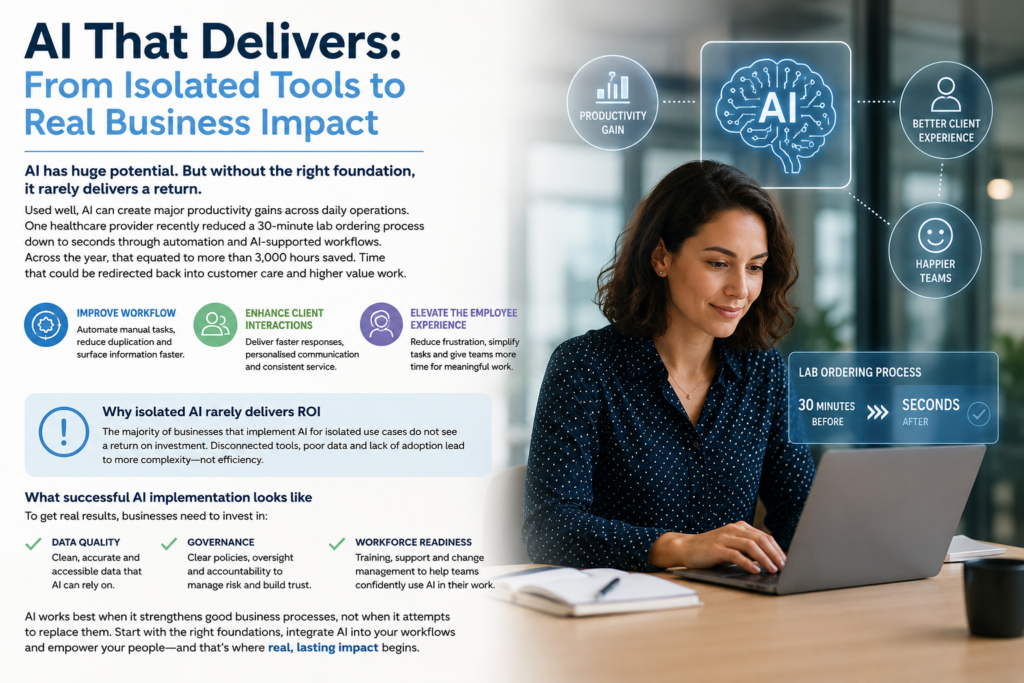
One healthcare provider recently reduced a 30-minute lab ordering process down to seconds through automation and AI-supported workflows. Across the year, that equated to more than 3,000 hours saved. Time that could be redirected back into customer care and higher value work.
The opportunities extend well beyond administration.
AI can improve workflow by automating manual tasks, reducing duplication and surfacing information faster. It can strengthen client interactions through quicker response times, personalised communication and improved service consistency.
Internally, it can also improve the employee experience by reducing frustration, simplifying tasks and giving staff more time to focus on problem solving and relationship building.
Why Many AI Projects Fail to Deliver ROI
However, many businesses are discovering that isolated AI implementation rarely delivers a meaningful return on investment.
Introducing a standalone AI tool into one part of the business without considering processes, systems, people and data often creates more complexity than efficiency. Teams can end up working around disconnected tools, inconsistent information and unclear ownership. Adoption slows and the expected benefits never fully materialise.
Successful AI Requires More Than Technology
Successful AI implementation requires more than selecting the latest platform.
Businesses need to invest in quality data, clear governance and workforce readiness. Staff need training and confidence in how AI supports their role. Processes need to be redesigned so AI integrates naturally into workflows rather than sitting beside them as an extra step.
The businesses seeing the strongest results are taking a structured approach. They start by identifying where teams are losing time, where customers experience friction and where repetitive work is slowing growth. From there, they assess which AI tools align with their operational goals and how those tools can be embedded into day-to-day operations.
AI Works Best When It Supports Good Operations
AI works best when it strengthens good business processes, not when it attempts to replace them.
For many businesses, the biggest opportunity right now is not implementing the most advanced AI solution. It is making practical operational improvements that remove friction, improve consistency and free people up to focus on higher value work.
The businesses that approach AI strategically today will be the ones building more efficient, scalable and resilient operations tomorrow.